
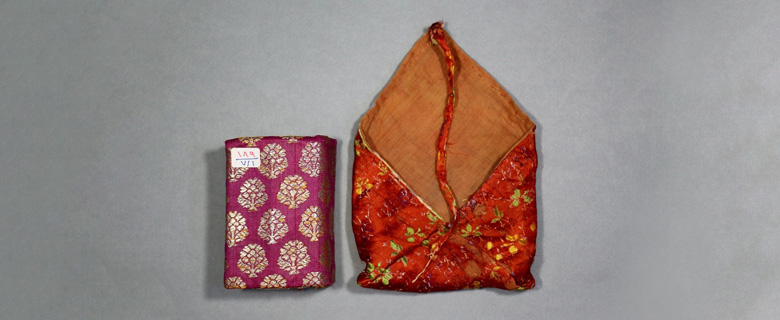
Although manuscripts have been the subject of much scholarly interest, many other aspects of book culture in the Islamic world have not been adequately researched. One of these is the protective enclosures—satchels, slipcases, chests, boxes, wrapping cloths and cloth bags—used to carry and preserve precious books. A formal study of slipcases1 was undertaken recently and another study of cloth bags is now ongoing.
Two of these bags are in the collection of the Qatar National Library.2 These bags have a simple structure. A square piece of cloth is lined with another thinner textile. Three corners of this square are then folded diagonally to the center of the cloth and adjacent edges stitched together to form the enclosure. The fourth corner remains open to create the mouth of the bag. Once the manuscript is placed into the bag, the flap can then be folded over to secure the manuscript inside (Figure 1).
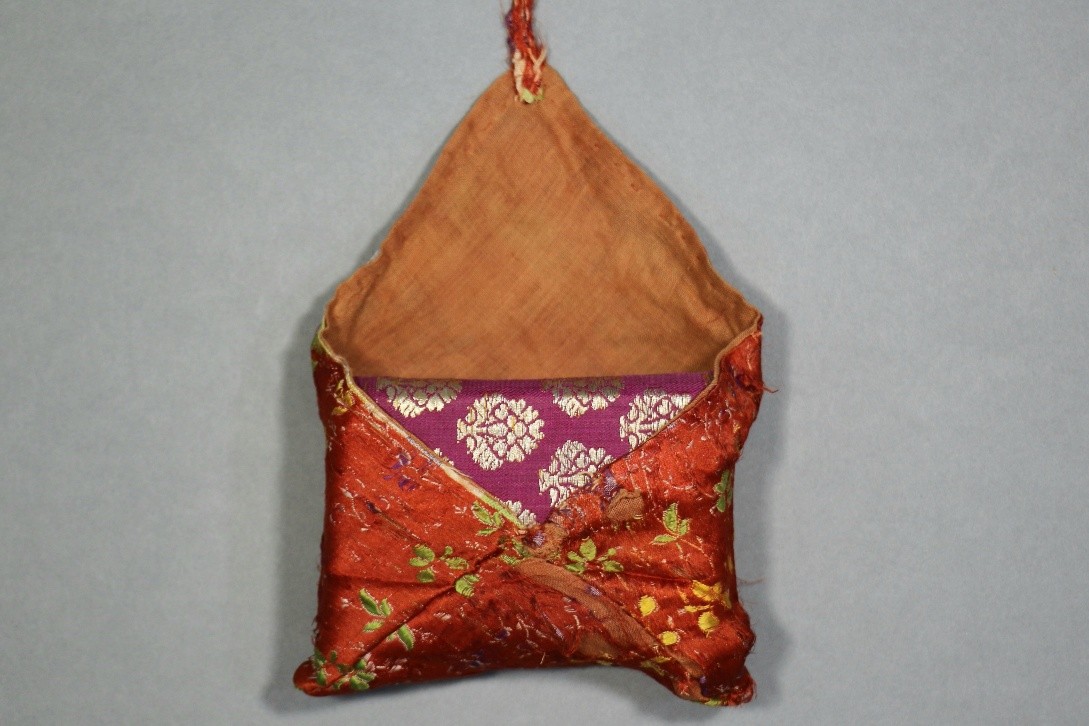
Figure 1. HC MS 00191, Qatar National Library. Manuscript bag shown partially open, revealing the inner lining and the folded textile structure used to enclose and protect the manuscript.
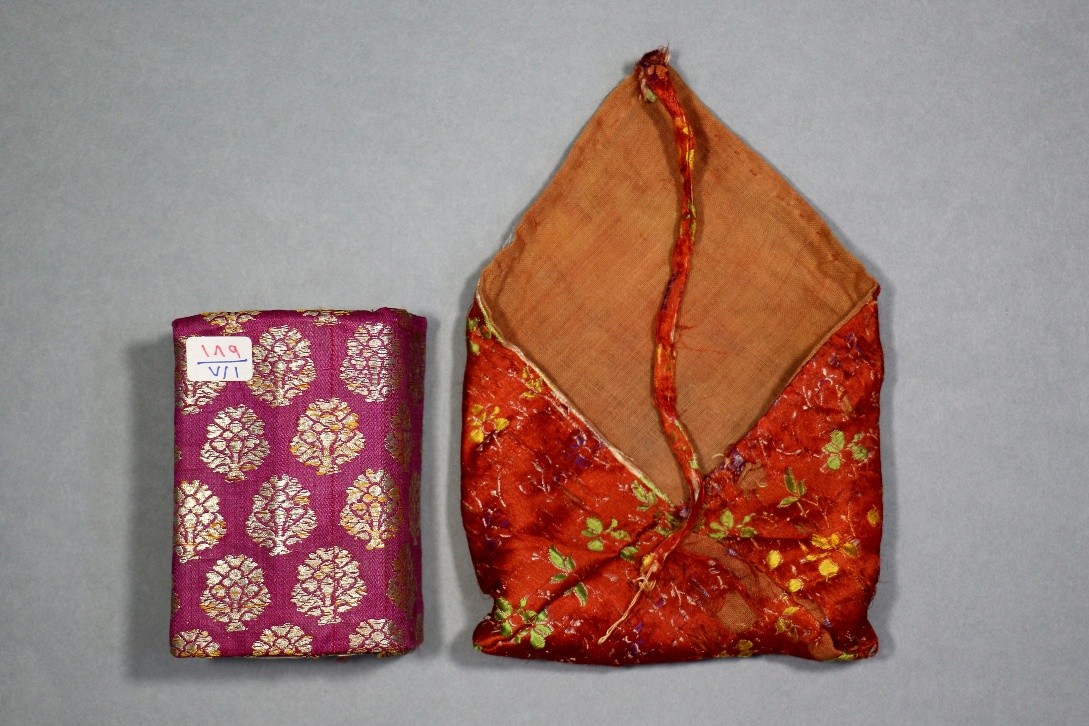
Figure 2. HC MS 00191, Qatar National Library. Manuscript bag shown open alongside the enclosed manuscript, illustrating the relationship between the textile enclosure and its contents.
Both of these bags are made from high quality textiles: embroidered silk (as seen in Figure 2)3 in one instance, handwoven woolen shawl fabric (as seen in Figure 3)4 in the other, with an additional inner wrapping cloth of silk. The use of these costly fabrics and their decorative, aesthetic appearance signify the importance of the manuscripts they contain and the social position of their owners. Thus they provide vital information about how the manuscripts were used, cared for and valued.
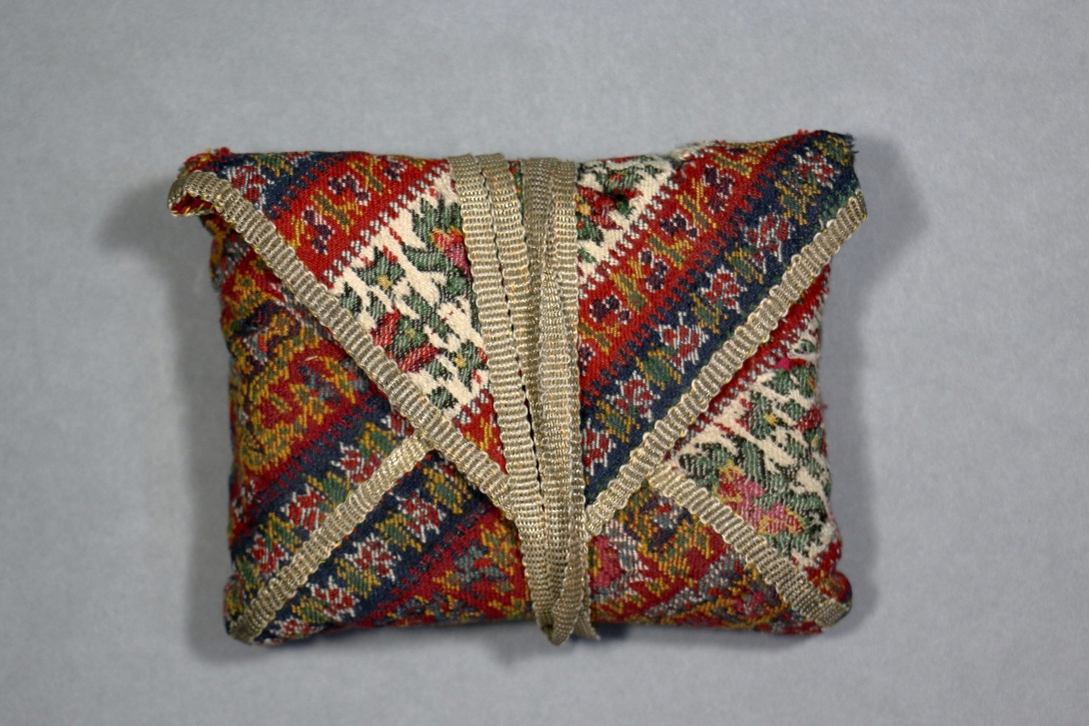
Figure 3. HC MS 00190, Qatar National Library. Closed manuscript bag showing the folded construction secured with a textile fastening and the patterned outer fabric.
Although the use of these bags is well-documented in paintings and photographs, relatively few of them survive in collections. They are easily separated from their associated manuscripts and vulnerable to destructive forces while performing their protective function. These two examples in the Qatar National Library collection are especially valuable because they remain associated with the manuscripts they were made to protect. So it is of particular interest to ensure that such remaining examples are documented and well cared for. Both bags are associated with complete Qur’anic manuscripts produced in the Indian Subcontinent during the 18th century. The manuscripts include additional devotional prayers at the beginning and end, suggesting sustained liturgical or personal use.5
Their preservation poses challenges to the conservator. If separated from the manuscript with which they are associated, they risk being lost. But if they are still used to enclose the manuscript, then abrasion, crushing and tearing can result, as can be seen in the silk bag in the QNL collection (Figure 4). In such cases it may be necessary to separate the bag from the manuscript so that it can be treated for any damage it has sustained and to prevent further damage, but it should then be kept in a separate compartment within the box where the manuscript is stored so that their association remains intact. On the other hand, as the wool bag in the QNL collection is stable and robust, perhaps the manuscript may be kept within the bag and then both placed together in a padded box. The presence of these bags should be included in catalog descriptions to make scholars aware of their existence and promote their further study.
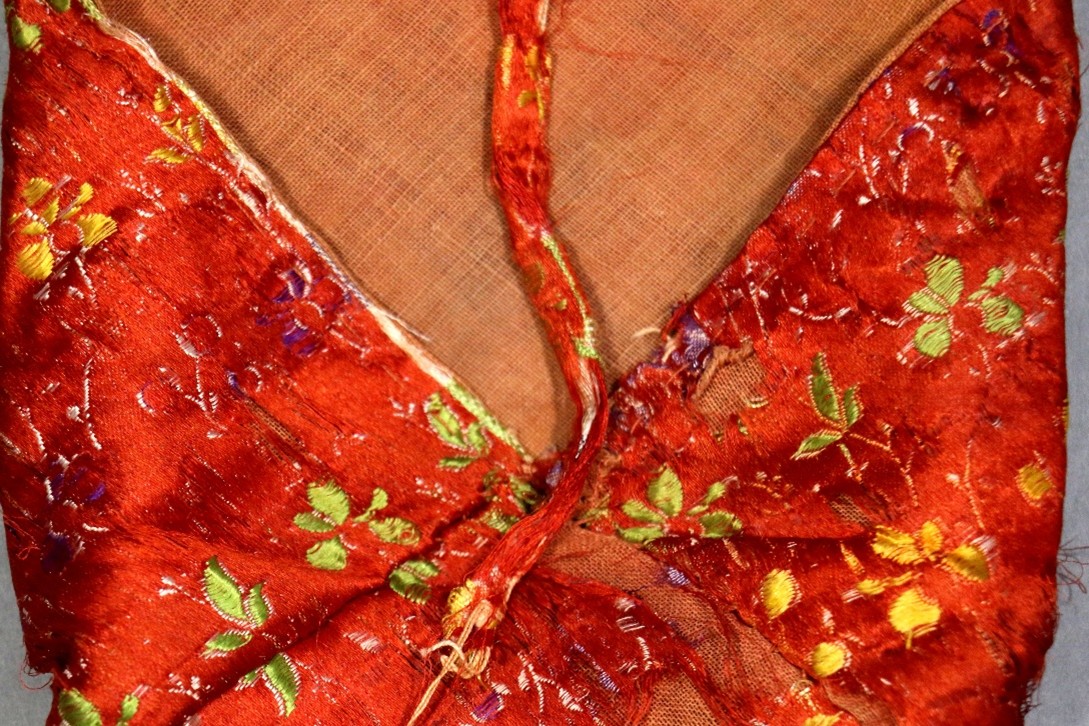
Figure 4. HC MS 00191, Qatar National Library. Detail of a silk manuscript bag from the QNL collection showing abrasion and tearing resulting from continued use as an enclosure.
Overall, these surviving manuscript bags offer a rare insight into how Islamic manuscripts were protected, carried, and valued. Although they were functional objects, their materials and decoration also reflect social meaning and status. By studying and preserving the few examples that remain, we can build a clearer picture of how these enclosures were made and used across regions, and how best to care for them today.
Current research by the author, in collaboration with David Plummer, Conservation Specialist at Qatar National Library, examines textile enclosures associated with Islamic manuscripts and contributes to a growing recognition of these often-overlooked objects within Islamic book culture.
The author would like to thank Dr Mahmoud Zaki, Manuscript Librarian and Curator at Qatar National Library, for his assistance in providing information on the associated manuscripts.
---------------------------
End Notes
1 David Plummer, Paul Hepworth, and Karin Scheper, ‘Between Bag and Box: Characteristics and Conservation Issues of the Islamic Slipcase’, in Suave Mechanicals: Essays on the History of Bookbinding, vol. 8, ed. Julia Miller (Ann Arbor, MI: The Legacy Press, 2023)
2 HC MSS 00190–00191
3 HC MS 00191
4 HC MS 00190
5 HC MS 00190 contains additional frontispieces with prayers preceding the Qur’anic text and further devotional material at the conclusion. HC MS 00191 is likewise a complete Qur’an and includes prayers following the main text. Both are likely of Indian Subcontinental origin and date to the early 12th century Hijri / 18th century.
Add new comment